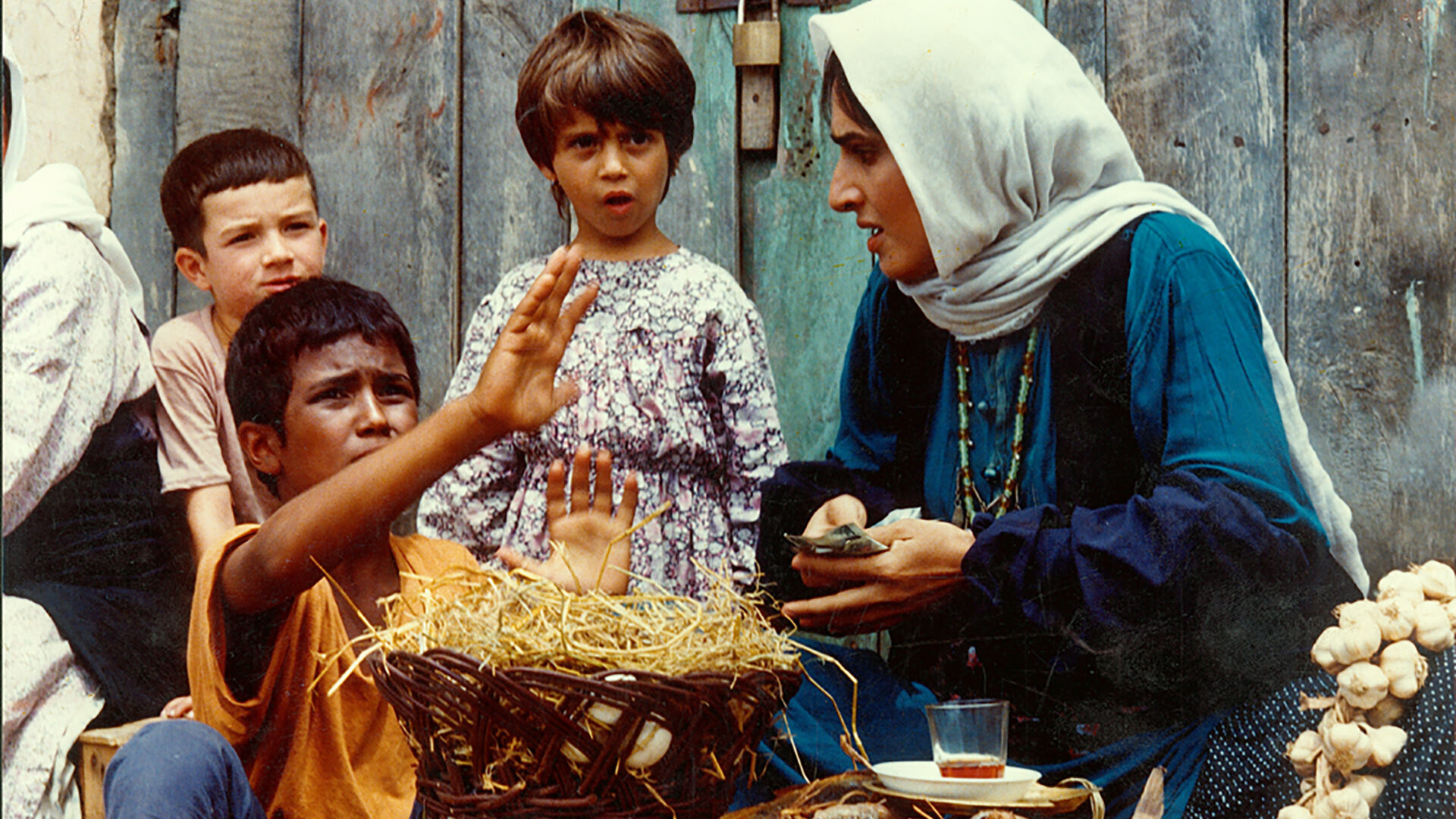
September 3–28, 2026
Immediate Experience: Early Films by Bahram Beyzaie & Amir Naderi
“To place Beyzaie and Naderi side by side is not to pose a rivalry, but to honour two esteemed auteurs and two orientations about what cinema can do … Their work expands what ‘Iranian cinema’ can sound and feel like beyond the internationally familiar image of poetic realism.”
Arta Barzanji, Metrograph Journal
For reasons both political and aesthetic, the complete story of Iranian cinema has never been fully available in North America. While international film culture was transformed by the emergence of Iranian directors in the 1990s, the decade in which Jafar Panahi and Abbas Kiarostami first won European festival awards, their work in that period was the culmination of a wide-ranging film movement that began to flourish in the 1970s.
Like Kiarostami, Bahram Beyzaie (1938–2025) and Amir Naderi (b. 1946) made films in the ’70s and ’80s through Kanoon, the Institute for the Intellectual Development of Children and Young Adults. The public institute’s educational aims foregrounded a pedagogical approach rare in any time: to reach children, artists and teachers would need to be as engaged, if not more so, in works of self-discovery and creation. This ethos made Kanoon a home for filmmakers with a penchant for testing the limits of freedom.
Without the existence of Kanoon, it would be hard to imagine Beyzaie and Naderi on a collision course. While both spent key parts of their childhood inside cinemas rather than classrooms, Beyzaie, by the time he started making films, had already established himself as a near-Wellesian presence in Iranian arts and culture, having penned several plays and authored a seminal work of history and theory titled, simply, A Study on Iranian Theatre. His grasp of global theatre traditions and the history of pre-20th century Iran remains singular among film directors. Naderi’s adolescent experience was less methodical. Orphaned at the age of five, he performed odd jobs until, as directly adapted in The Runner, he began to develop his own artistic voice.
The Runner is almost surely Naderi’s masterpiece, and it was edited by Beyzaie. Similar path-crossing collaborations happen across the filmographies of their generation. Naderi was, for a time, Kiarostami’s roommate, and he co-wrote Kiarostami’s first feature, Experience. Naderi’s Harmonica was edited by Sohrab Shahid Saless (Far From Home), and the cinematographer of The Runner, Firooz Malekzadeh, would later shoot Beyzaie’s Bashu, the Little Stranger, which has, decade after decade, been called by Iranian critics the greatest film ever produced in the country.
The narrative foregrounding of children heightens, both for a director on a film set and in the formal properties of their filmmaking, the subjective experience of time and the significance of language. But inasmuch as there is an Iranian tradition of children in cinema, Naderi’s personality as a filmmaker is wildly different from Kiarostami’s, and Beyzaie’s films with children explode the popular concept of the Iranian New Wave and its successors as merely a step away from European traditions of neo- or poetic realism. Both artists eventually found themselves exiled from Iran in North America; this series captures their work during a period when they could portray the dreams and conflicts that were personal to them with a clarity that still resonates today.
The Cinematheque is excited to present a selection of Beyzaie’s and Naderi’s early works, each of them recently restored, and all of them major discoveries. The series will open with Bashu, the Little Stranger, preceded by an introduction from filmmaker and editor Sam Mohseni.
“We learned from [Bahram Beyzaie] how to stand against forgetfulness.” Jafar Panahi
“Before the revolution, we were forced to express ourselves through signs, through symbols. That gave us a tremendous opportunity to create images. After the revolution, all these images are right there, in front of us, laid bare, and that’s when the difficulty begins.” Amir Naderi
“Through Beyzaie’s lens, Iranian identity is elemental, built into the ecology, into the landscape, and the air. It cannot be defined by lawmakers or taken away by reckless bombing campaigns.” Johnny Massahi, Little White Lies
“Naderi is an explosive filmmaker … His body of work is driven by extraordinary visual energy and fueled by his fervour and adoration for filmmaker-editors, from Eisenstein to Kurosawa.” Jean-Philippe Tessé, Cahiers du cinéma
List of Programmed Films
| Date | Film Title | Director(s) | Year | Country |
|---|---|---|---|---|
| 2026-Sep | Bashu, the Little Stranger | Bahram Beyzaie | 1986 | Iran |
| 2026-Sep | Journey + The Runner | |||
| 2026-Sep | Experience + Waiting | |||
| 2026-Sep | Downpour | Bahram Beyzaie | 1972 | Iran |
| 2026-Sep | Harmonica | Amir Naderi | 1974 | Iran |
Note
Bahram Beyzaie’s first film Uncle Moustache also plays in September as part of our monthly Film Club series.